
ENGINEERING & ASSET ADVISORY
Integrating engineering judgement with data-driven decision making
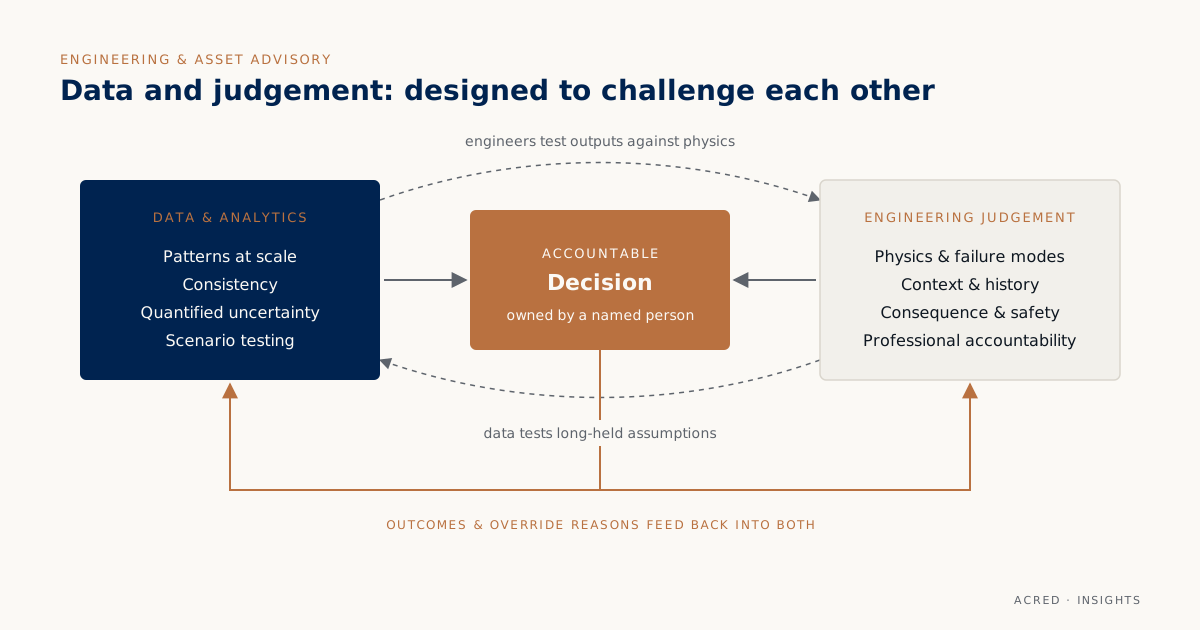
Data and AI can reveal patterns that are difficult to detect manually. Engineers bring physics, context and consequence that data alone cannot provide. The best decisions come from designing the two to work together — deliberately.
A false choice
Debates about data versus experience often set up a false choice. On one side: "the data doesn't lie". On the other: "you can't model thirty years in the field". Both are partly right and dangerously incomplete.
| Data and analytics are strong at | Engineering judgement is strong at |
|---|---|
| Detecting patterns across thousands of assets | Understanding failure mechanisms and physics |
| Consistency — no fatigue, no anchoring on recent events | Recognising when data is implausible or incomplete |
| Quantifying trends and uncertainty | Applying context: operating environment, history, design intent |
| Rapidly testing many scenarios | Weighing consequences, safety and community impact |
| Surfacing what was previously invisible | Being professionally accountable for the outcome |
Each has characteristic failure modes. Models can be confidently wrong when data is biased, incomplete or when conditions change outside the training range. Human judgement is subject to well-documented biases — overconfidence, anchoring and availability — and to automation bias, where people defer too readily to automated advice (Parasuraman & Manzey, 2010).
Accountability doesn't transfer to an algorithm
In Australia, professional and legal obligations depend on jurisdiction, discipline and work type. Engineers Australia's Code of Ethics requires members to practise competently and within their areas of competence. Victoria's registration scheme applies to professional engineering services in five prescribed areas; Queensland broadly regulates professional engineering services through RPEQ, subject to supervision and prescriptive-standard exceptions; and NSW's Design and Building Practitioners scheme applies to professional engineering work for regulated Class 2, 3 and 9c buildings.
Using a model, vendor product or dashboard does not remove an engineer's applicable professional duties, although accountability and legal liability may be shared among engineers, employers, suppliers and other duty holders. Government AI guidance reflects the same principle: Australia's Guidance for AI Adoption lists "Maintain human control" and "Decide who is accountable" among its six essential practices.
The practical implication: data-driven tools must be designed so that a qualified person can understand, challenge and stand behind the decision they support.
Designing the integration deliberately
1. Make the decision explicit
ISO 55001:2024 now requires a documented asset management decision-making framework (clause 4.5), with defined criteria and an understanding of value. Specify which decisions analytics will inform, what evidence is required, and who decides.
2. Match the level of automation to the consequence
Not every decision needs the same level of human involvement. The following is an illustrative governance pattern; legal, safety and assurance requirements may require different controls:
| Consequence of a wrong decision | Appropriate model |
|---|---|
| Low, easily reversed (e.g. inspection scheduling order) | Automated, with periodic review |
| Moderate (e.g. maintenance prioritisation) | Analytics recommends; engineer approves |
| High or safety-critical (e.g. asset retirement, structural integrity, protection settings) | A qualified decision owner approves or authorises the decision, supported by analytics, documented controls and independent verification where required |
3. Use physics as a check on data — and data as a check on assumptions
Engineers should test model outputs against known failure mechanisms and physical limits. Equally, data should challenge long-held rules of thumb — for example, replacement intervals set decades ago that no longer reflect actual degradation.
4. Make uncertainty visible
A single number invites false confidence. Present ranges, confidence and the data that drove a result, so engineers can judge how much weight it deserves. ISO 31000:2018 reminds us that risk is the effect of uncertainty on objectives — hiding uncertainty hides risk.
5. Capture judgement, not just outcomes
When engineers override a model, record why. Those reasons are valuable data: they reveal model blind spots and capture expertise that would otherwise be lost — a point reinforced by ISO 55001:2024's new clause 7.7 on organisational knowledge.
6. Close the loop
Track what actually happened after decisions are made. Without outcome feedback, neither the model nor the engineer can learn.
Signs the balance is wrong
- Engineers routinely ignore model outputs — or never question them.
- No one can explain why the model ranked an asset as high risk.
- Overrides are not recorded or analysed.
- Investment cases cite "the model says so" without engineering rationale.
- Experienced staff are leaving and their knowledge isn't captured anywhere.
Frame
Define the decisions, their consequences and who is accountable for them.
Equip
Apply analytics and AI suited to the decision and the available data, designed to be explainable.
Validate
Engineers challenge outputs against physics, failure mechanisms and field experience; data challenges assumptions.
Deliver
Decision processes, records and feedback loops that make combined human–data decisions transparent and defensible.
Technology widens what we can see. Engineering judgement decides what to do about it — and stands behind the decision.
References
- ISO, ISO 55001:2024 — asset management system requirements and ISO 31000:2018 — risk management guidelines.
- Engineers Australia, Code of Ethics.
- Consumer Affairs Victoria, who needs to be registered as a professional engineer.
- Board of Professional Engineers of Queensland, RPEQ registration and scope.
- NSW Government, professional engineers' obligations for regulated buildings.
- Australian Government, Guidance for AI Adoption.
- Parasuraman and Manzey (2010), Complacency and bias in human use of automation, Human Factors 52(3), 381–410.