
ENGINEERING & ASSET ADVISORY
Why asset data quality limits digital transformation
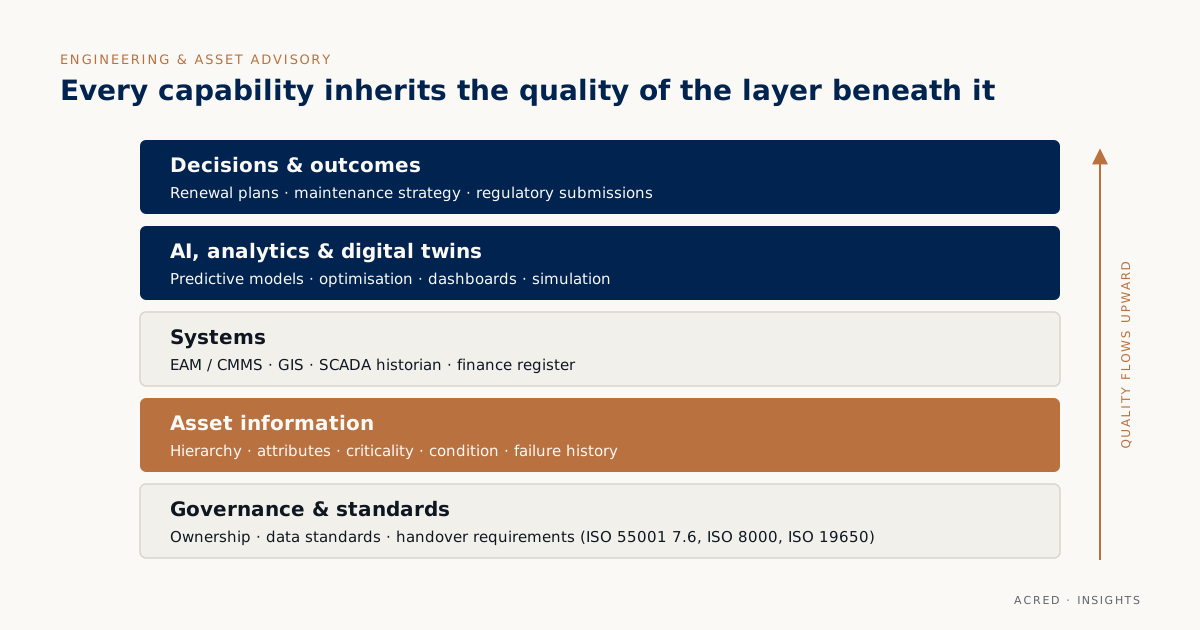
Digital twins, predictive maintenance and AI all inherit the quality of the asset register beneath them. Why asset information is the real constraint on transformation, and how to fix it without a decade-long data program.
The foundation nobody budgets for
Asset-intensive organisations routinely invest in new enterprise asset management (EAM) platforms, GIS upgrades, sensor networks and analytics. Far fewer invest proportionately in the information those systems consume: the asset hierarchy, attributes, criticality ratings, condition scores and failure histories.
The result is familiar to anyone who has worked in a utility, transport operator or council:
- The same asset appears in the EAM, GIS and finance register under three different identifiers.
- Install dates default to the date the record was migrated.
- Condition scores were last updated during a one-off survey years ago.
- Failure codes are "OTHER" in a large proportion of work orders, with the real story buried in free text.
- Nobody can say with confidence how many assets of a given class are in service.
None of this stops day-to-day operations — experienced staff know where the gaps are. But it constrains and undermines digital transformation, because algorithms and dashboards do not automatically know where the gaps are.
The standards now make data quality explicit
The 2024 revision of the asset management standard raised the bar. ISO 55001:2024 clause 7.6 (Data and information) now requires organisations to determine the data and information needed to support asset management, specify it, and plan for its collection, integration, quality improvement and sharing. A new clause 7.7 adds requirements for organisational knowledge — capturing what experienced people know before it walks out the door.
Other standards provide the "how":
- ISO 8000 describes data quality in terms of how well data's inherent characteristics fulfil requirements — meaning you must first state what "good enough" is for each use.
- ISO 19650 sets out information management across the lifecycle of built assets, including the asset information requirements (AIR) that should flow from project delivery into operations.
- DAMA-DMBOK offers a widely used set of data quality dimensions: completeness, accuracy, consistency, timeliness, validity and uniqueness.
Why it matters financially
Poor data is expensive in ways that rarely appear on a single budget line. Gartner research published in 2021 estimated that poor data quality costs organisations an average of US$12.9 million a year across industries. This is a directional benchmark, not an asset-management-specific measure. In asset management, the costs show up as:
| Symptom | Hidden cost |
|---|---|
| Unreliable condition and age data | Capital renewed too early or too late; weak business cases to Treasury or regulators |
| Duplicate or missing assets | Maintenance scheduled for assets that don't exist, missed for those that do |
| Poor failure coding | Reliability analysis impossible; the same failures recur |
| Disconnected project handover | New assets enter operations without the information to maintain them |
| Low trust in the register | Staff build private spreadsheets, multiplying versions of the truth |
The handover gap
One of the most persistent sources of poor asset data is the transition from capital projects to operations. Projects are measured on time, cost and scope; the quality of the asset information they hand over is often an afterthought. Without clear asset information requirements written into contracts — as ISO 19650 and good practice under ISO 55001 both encourage — every new project adds to the backlog.
A practical way forward: fit-for-decision, not perfect
Organisations stall when they treat data quality as a one-off cleansing exercise across every attribute of every asset. A more effective approach is to work backwards from decisions:
- Start with priority decisions. Which renewal, maintenance or risk decisions matter most this year? What information do they need?
- Define "good enough" per attribute. Criticality for high-consequence assets may need near-complete accuracy; a low-value attribute may not need collecting at all.
- Profile and measure. Baseline quality against the dimensions above so improvement can be tracked and reported.
- Use technology to accelerate remediation. Record matching, anomaly detection and language models can reconcile registers and extract structure from free text — with specialists reviewing the changes.
- Fix the source. Embed data standards in work-order closure, field mobility apps and project handover so quality doesn't decay again.
- Assign ownership. Every critical data set needs an accountable owner, not just a system administrator.
Frame
Link information requirements to your asset management objectives and priority decisions.
Equip
Use profiling, matching and AI-assisted extraction to find and fix issues at scale.
Validate
Engineers confirm that corrected data reflects physical reality on the ground.
Deliver
Embed governance, handover requirements and quality measures so improvement is sustained.
Better asset data is not an IT project. It is the precondition for every confident asset decision.