
DATA & AI / ASSETS
Where AI genuinely creates value in asset management
AI earns its place in asset management where it improves a specific lifecycle decision, not where it decorates a dashboard. A practical view of where it works, where it doesn't, and what has to be true first.
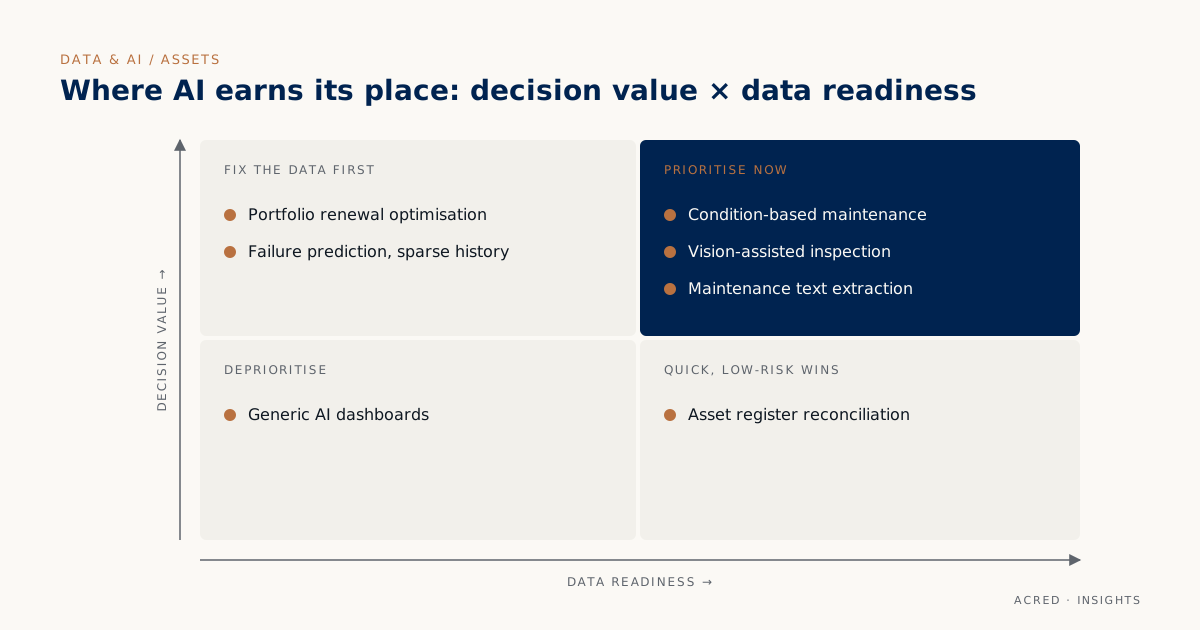
The question is not "where can we use AI?"
Most asset-intensive organisations already hold more data than they use: condition monitoring, SCADA historians, inspection images, work-order histories, GIS layers and decades of maintenance notes. The temptation is to point AI at that data and see what emerges.
That approach rarely survives contact with operations. The more useful question is: which asset decisions are made frequently, carry material consequences, and are currently made with poor or slow information? Those decisions are where AI can genuinely change outcomes.
The international standard for asset management now frames the problem the same way. ISO 55001:2024 introduced a new requirement (clause 4.5) for organisations to establish an asset management decision-making framework that defines what "value" means and the criteria by which decisions are made across the asset lifecycle. It also strengthened requirements for data and information (clause 7.6) and replaced "preventive action" with "predictive action" (clause 10.3). AI is most defensible when it plugs directly into that framework rather than sitting beside it.
Five areas where AI consistently earns its place
1. Condition-based and predictive maintenance
Where assets are instrumented (rotating plant, pumps, transformers, rolling stock), anomaly detection and remaining-useful-life models can move maintenance from calendar-based to condition-based. The value is not the model; it is fewer unnecessary interventions and earlier warning of the failures that matter. This works best on high-criticality assets with well-understood failure modes and reliable sensor history.
2. Computer vision for inspection
Drone, vehicle-mounted and fixed-camera imagery of poles, bridges, pipelines, rail corridors and building façades can be screened by computer vision so engineers review the exceptions rather than every frame. The engineer stays in the loop; the model triages. The gains are in inspection coverage, consistency and turnaround, not in removing the inspector.
3. Unlocking maintenance text
A large share of asset knowledge sits in free-text work orders and technician notes. Researchers from NIST, the University of Western Australia and industry have shown that technical language processing can extract failure modes, components and actions from maintenance records that structured fields miss (Brundage et al., 2021). Modern language models make this far more accessible, and it can produce early value because the data already exists.
4. Investment prioritisation and scenario modelling
Optimisation and simulation help compare renewal, refurbishment and run-to-failure strategies across a portfolio under budget and risk constraints. Here AI supports — it does not replace — the value and risk trade-offs that ISO 55001's decision-making framework requires leaders to own.
5. Asset information quality itself
Ironically, one of the highest-value uses of AI is improving the data that every other use case depends on: matching duplicate asset records, inferring missing attributes, reconciling GIS with the asset register, and flagging implausible values for review. (See our companion insight, Why asset data quality limits digital transformation.)
Where value usually fails to appear
| Pattern | Why it underdelivers |
|---|---|
| Predictive models on assets with no clear failure history | Not enough failures to learn from; outputs can't be validated |
| Dashboards without a decision owner | Insight is generated but nobody is accountable for acting on it |
| Models built on an unreconciled asset register | Predictions are attached to the wrong or duplicated assets |
| "Platform first" programs | Large spend before a single decision has improved |
| No feedback loop from field outcomes | The model never learns whether it was right |
Industry evidence reinforces this. In 2024, Gartner forecast that at least 30% of generative AI projects would be abandoned after proof of concept by the end of 2025, citing poor data quality, inadequate risk controls, escalating costs and unclear business value. Those causes point to framing, governance and operating-model failures — not model performance alone.
What has to be true before AI adds value
- A named decision and decision owner. "Which 5% of pipe segments do we renew this year?" is a decision. "Use AI on our network data" is not.
- Fit-for-purpose asset information. Asset hierarchy, criticality and failure history must be trustworthy enough for the decision at hand — not perfect, but known.
- Engineering validation. Outputs must be tested against known failure modes, physical plausibility and field experience before they influence spend or safety.
- Governance proportional to consequence. Australia's Guidance for AI Adoption (National AI Centre, 2025) sets six essential practices — including deciding who is accountable, measuring and managing risk, testing and monitoring, and maintaining human control. ISO/IEC 42001:2023 provides the management-system equivalent.
- A path into the operating rhythm. The output has to land in the work-management system, the capital plan or the inspection schedule — where decisions actually happen.
Frame
Start from the decision and the asset management objectives in your Strategic Asset Management Plan, not from the dataset.
Equip
Select the simplest method that will improve that decision: sometimes a well-built rule, sometimes machine learning, sometimes computer vision.
Validate
Engineers and data specialists jointly test outputs against physical reality, failure history and risk tolerance.
Deliver
Embed outputs into maintenance and investment processes, with clear ownership and a feedback loop that measures whether decisions improved.
Technology powers the analysis. Engineering judgement decides what it means for your assets.
References
- ISO, ISO 55001:2024 — Asset management system requirements and summary of key changes.
- Brundage et al. (2021), Technical language processing: Unlocking maintenance knowledge, Manufacturing Letters 27, 42–46.
- Gartner (2024), forecast on generative-AI projects after proof of concept.
- Australian Government, Guidance for AI Adoption.
- ISO, ISO/IEC 42001:2023 — AI management systems.
- NIST, Artificial Intelligence Risk Management Framework 1.0.